
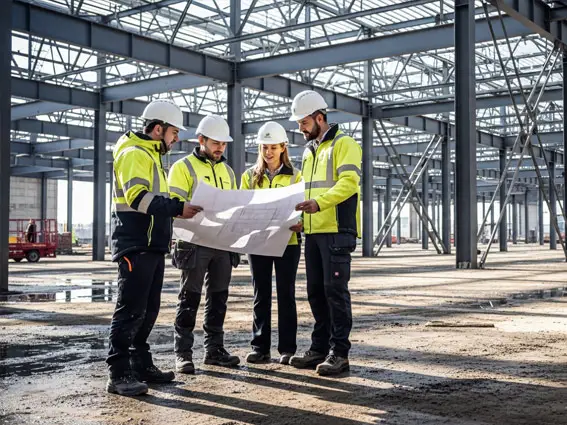
Construction projects often involve many different stakeholders, from clients and project managers to contractors, consultants, and suppliers. To ensure that the project is carried out in accordance with the contract, technical requirements, and schedule, a clear structure within the project organization is needed.
An important role in this organization is the construction manager. But what exactly does a construction manager do, and what function does the role have in a construction project?
In this article, we go through the construction manager’s responsibilities, tasks, and competency requirements, as well as how the role contributes to ensuring quality and progress in construction projects.
The Role of the Construction Manager in Construction Projects
The construction manager often works on behalf of the client or project management team and is responsible for monitoring the contractor’s work during the construction phase. The role involves ensuring that the project is carried out in accordance with the contract, drawings, and technical requirements.
Byggledaren fungerar därför som en viktig länk mellan flera olika aktörer i projektet, exempelvis:
- Client
- Project management
- Contractors
- Specialists and Technical Consultants
- Suppliers
By monitoring the work during production and ensuring that the project is carried out according to plan, the construction manager helps create confidence in the project’s execution.
Production Follow-Up
One of the construction manager’s most important tasks is to monitor the work carried out on the construction site. This involves ensuring that the contractor performs the work in accordance with the project’s technical documents and agreed requirements.
The work may, for example, include:
- Participate in construction meetings and production meetings
- Monitor work activities during production
- Ensure that the work is carried out according to drawings and specifications
- Identify and report any deviations
Through this follow-up, potential issues can be identified at an early stage, and actions can be taken before the project’s schedule or budget is affected.
Coordination Between Project Stakeholders
Construction projects often involve multiple contractors and technical disciplines that need to be coordinated. The construction manager therefore plays an important role in ensuring that communication between the various stakeholders functions effectively.
This may include:
- Coordinate matters between contractors and project management
- Help resolve technical issues in the project
- Ensure that decisions are communicated to relevant parties
When many stakeholders work in parallel within a project, this coordination becomes crucial to avoid misunderstandings and disruptions in production.
Quality and Technical Control
Quality is a central part of all construction projects, and the construction manager often has significant responsibility for ensuring that the work meets the project’s requirements.
This may involve:
- Ensure that the work is carried out according to drawings and technical specifications
- Following up on quality controls and self-inspections
- Ensure that documentation and reporting are carried out correctly
- Help identify and manage deviations
Through this oversight, the construction manager helps ensure that the project’s outcome meets the required technical standards.
Documentation and reporting
The construction manager often works to document the project’s progress and report status to the client or project management team.
This may include:
- Document important events in the project
- Review the contractor’s reporting
- Contribute to the project’s construction log
- Compile documentation for project follow-up
Documentation is important because it provides a clear picture of how the project is progressing and can be crucial when following up on contracts and finances.
Resource Monitoring in the Project
For a construction project to be carried out efficiently, resources must be used properly. The construction manager may therefore also work on monitoring how the project’s resources are utilized during production.
This may involve:
- Monitoring staffing and work tasks
- Ensure that the work is carried out according to plan
- Identify risks in production
- Contribute to better oversight of the project’s progress
Through this monitoring, the project organization can identify deviations early and adjust the planning when necessary.
Experience and education
Many construction managers have a technical education in construction or civil engineering. Common educational paths include, for example:
- Construction engineering
- Master of Science in Civil Engineering or Construction Engineering
- Technical university programs
- Vocational higher education in construction production
In addition to education, practical experience from construction projects is often highly valuable. Many construction managers have previously worked as site managers, project engineers, or project managers, for example.
This experience provides a strong understanding of how construction projects function in practice.
Personal qualities in the role
Several important qualities are required to perform well in the role of a construction manager.
Since the role involves monitoring and coordinating work during production, the construction manager often needs to be:
- Structured and detail-oriented
- Communicative and clear
- Analytical and solution-oriented
- Responsible
The construction manager also needs to be able to handle situations where problems arise in the project and contribute to solutions that work for the entire project organization.
Courses and professional development
Continuous professional development is important for construction managers, as the industry evolves rapidly and new working methods and digital tools are constantly being introduced.
Examples of valuable training include:
- Project management in construction projects
- Construction law
- Work environment and safety
- Quality Management in Construction Projects
- Digital Tools and Project Platforms
By combining technical expertise, experience from construction projects, and continuous professional development, construction managers can develop into key individuals within the project organization.
Challenges in the Role of a Construction Manager
Working as a construction manager also involves several challenges. The role often requires managing complex projects with many stakeholders involved and where changes may arise throughout the course of the project.
Common challenges may include, for example:
- Managing technical issues during production
- Coordinating multiple contractors simultaneously
- Ensuring quality while keeping the project on schedule
- Managing changes in project execution
To succeed in the role, both technical understanding and a strong ability to create structure within the project are required.
The Construction Manager’s Role in Inspections
Inspections are an important part of the construction process and are intended to ensure that the work has been carried out in accordance with the contract, technical documentation, and applicable quality requirements. In many projects, the construction manager plays an active role in the preparations for various types of inspections, such as pre-inspections, final inspections, or warranty inspections. This often involves monitoring the contractor’s work, ensuring that necessary documentation is available, and making sure that any deficiencies are addressed before the inspection takes place. During the inspection itself, the construction manager may assist the client and inspector by explaining the project’s execution, answering questions about the production process, and helping identify any deviations. After the inspection, the construction manager often participates in following up on noted issues and ensures that the contractor carries out the necessary corrective actions according to the agreed schedule.